.png?alt=media&token=bfcc71bf-04da-4200-badf-6c9f66c06a3c)
How to Reduce Electricity Bill in Summer 2026: 15 Proven Ways
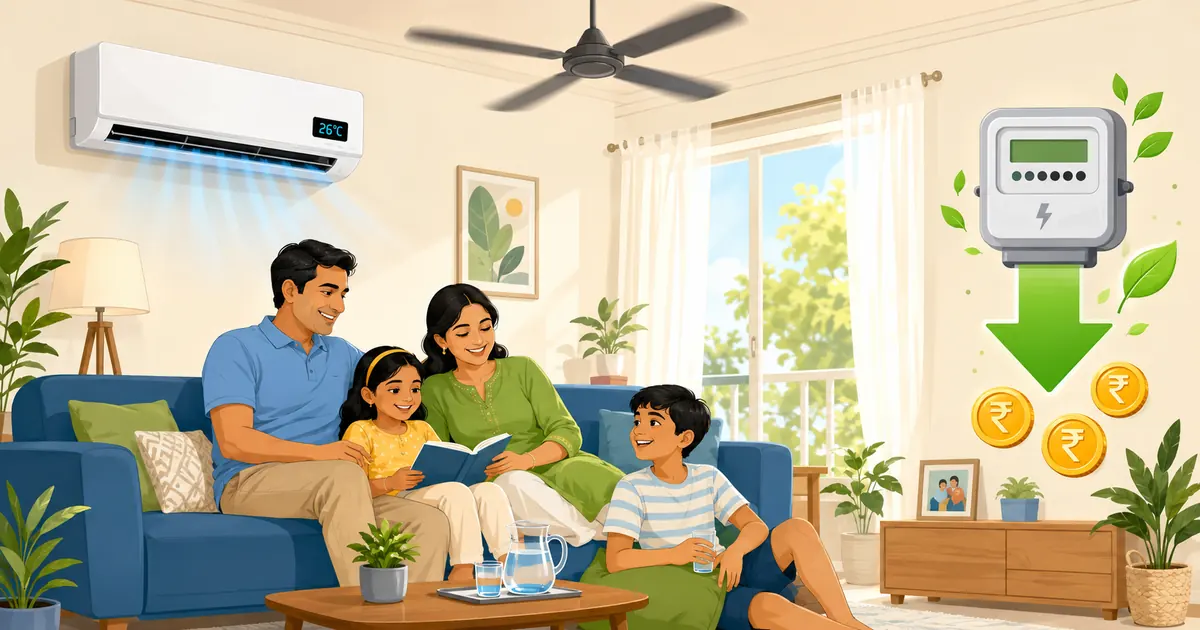
Quick answer: To reduce your electricity bill in summer, set your AC to 24–26°C, run a ceiling fan alongside it, clean AC filters every 2–3 weeks, switch all bulbs to LEDs, unplug idle devices, run washing machines on full loads only, and consider rooftop solar if your monthly usage is high. Experts estimate 30–40% of a typical summer bill is preventable through better habits and maintenance alone.
Why Your Electricity Bill Is Exploding This Summer
Summer 2026 has been brutal. A prolonged heatwave pushed India's power demand to record highs, and most households are running their AC almost non-stop. On top of that, several state distribution companies revised rates — for example, UPPCL announced a 10% FPPAS (fuel) surcharge for June 2026 bills, though the state regulator UPERC later questioned the calculation and asked UPPCL to justify it.
So you're paying for more units AND paying more per unit. The result: bills that make you wince.
Here's the good news experts keep repeating — 30 to 40% of a typical summer electricity bill is preventable through smarter habits, basic maintenance, and the right appliance choices. This guide gives you 15 proven ways to cut your bill, with the realistic rupee savings for each. And because India's grid emits roughly 0.7 kg CO₂ per unit (latest available CEA grid emission factor), every rupee you save also cuts your carbon footprint — we've shown that impact too.
First: Understand What's Driving Your Bill
In most Indian homes during summer, the breakdown looks roughly like this:
| Load | Share of summer bill |
|---|---|
| Air conditioning | 40-60% |
| Refrigerator | 10-15% |
| Lighting | 5-10% |
| Water heater / geyser | 5-10% |
| Fans, TV, electronics, phantom load | 10-20% |
The AC is the giant. Fix that first, then chip away at the rest.
15 Proven Ways to Reduce Your Electricity Bill
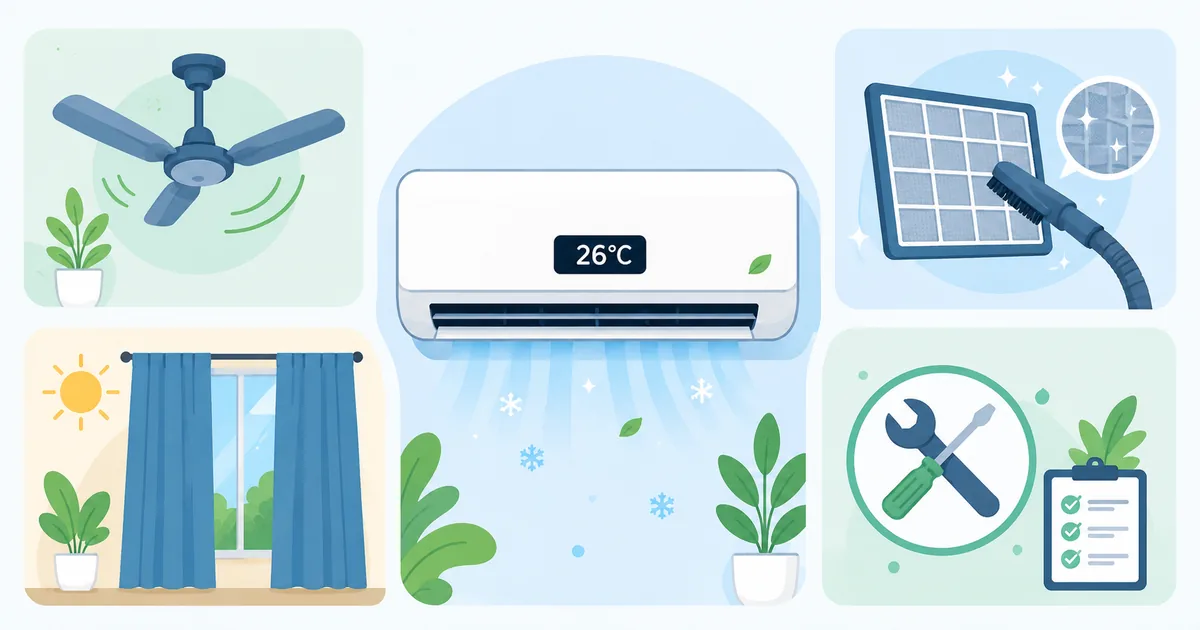
❄️ Cooling — Where the Biggest Savings Hide
1. Set your AC to 24–26°C and run a ceiling fan
This single change is the highest-value tip. The Bureau of Energy Efficiency (BEE), under the Ministry of Power, says raising your AC temperature by just 1°C saves about 6% electricity, and recommends 24°C as the comfort-and-savings sweet spot. At 24–26°C with a fan circulating air, the room feels cooler than the thermostat reading, but the compressor runs far less.
Savings: ₹700-2,500/month per AC · CO₂ cut: ~50-180 kg/month
2. Clean your AC filters every 2-3 weeks
A clogged filter forces the AC to work harder for the same cooling. Cleaning filters can improve efficiency by 5-15%.
Savings: ₹200-600/month · Cost: ₹0 (do it yourself)
3. Get your AC serviced before peak summer
Low refrigerant, dusty coils, and a dirty outdoor unit all spike consumption. One annual service (₹400-600) pays for itself within a month.
Savings: ₹300-800/month
4. Use the timer and sleep mode at night
You don't need the AC blasting at 3 AM. Sleep mode gradually raises the temperature, and a timer shuts it off after you're asleep.
Savings: ₹400-1,000/month
5. Seal gaps and close curtains during the day
Cool air leaking out and sunlight pouring in both make the AC overwork. Block direct sun with curtains; seal door/window gaps.
Savings: ₹200-500/month
6. Upgrade to a 5-star inverter AC (if buying)
A 5-star 1.5-ton AC uses ~750 units/year versus ~1,000 units for a 3-star — saving roughly ₹2,000/year at ₹8/unit, with payback in about 4-5 years. The 5-star inverter (ISEER 5.0+) also runs quieter and lasts longer.
Savings: ~₹2,000/year · CO₂ cut: ~180 kg/year
💡 Lighting & Appliances
7. Switch every bulb to LED
LEDs use 70-80% less energy than incandescent bulbs and last far longer. A full-home switch is one of the cheapest high-return upgrades.
Savings: ₹150-400/month · CO₂ cut: ~50-150 kg/year
8. Kill phantom load — unplug idle devices
TVs, set-top boxes, chargers, and microwaves draw power on standby. Phantom load can be 5-10% of your bill. Use a switchable power strip.
Savings: ₹100-300/month
9. Set your refrigerator to the right temperature
Fridge at 3-4°C and freezer at -18°C is ideal. Colder than needed just wastes power. Don't overfill, and let hot food cool before storing.
Savings: ₹100-250/month
10. Run washing machine and dishwasher on full loads only
A half load uses nearly the same power and water as a full one. Consolidate, and wash with cold water where possible.
Savings: ₹100-200/month
🚿 Water Heating & Habits
11. Lower your geyser temperature and insulate it
In summer you rarely need a scalding geyser. Lower the thermostat, and an insulation jacket reduces standby heat loss.
Savings: ₹150-400/month
12. Switch heavy appliances to off-peak hours
Many states are rolling out Time-of-Day (ToD) tariffs where night/off-peak units are cheaper. Run the washing machine, geyser, and iron during off-peak windows.
Savings: ₹100-400/month (where ToD applies)
13. Use natural ventilation in early morning and late evening
When the outside temperature drops below indoor temperature, open windows and switch off the AC. Cross-ventilation is free cooling.
Savings: ₹200-600/month
☀️ The Big Structural Moves
14. Install rooftop solar
This is the ultimate bill-killer. A 3 kW system generates 360-450 units/month — enough to wipe out most of an average family's bill — and avoids ~4 tonnes CO₂/year. Under the PM Surya Ghar scheme you get up to ₹78,000 central subsidy. See our PM Surya Ghar guide.
Savings: ₹2,000-4,000/month · CO₂ cut: ~4 tonnes/year
15. Track your usage and find your biggest drain
What gets measured gets managed. Check your monthly units, identify your biggest load, and target it first. Use our free Carbon Footprint Calculator to see your electricity emissions and how reducing them cuts both your bill and your carbon footprint.
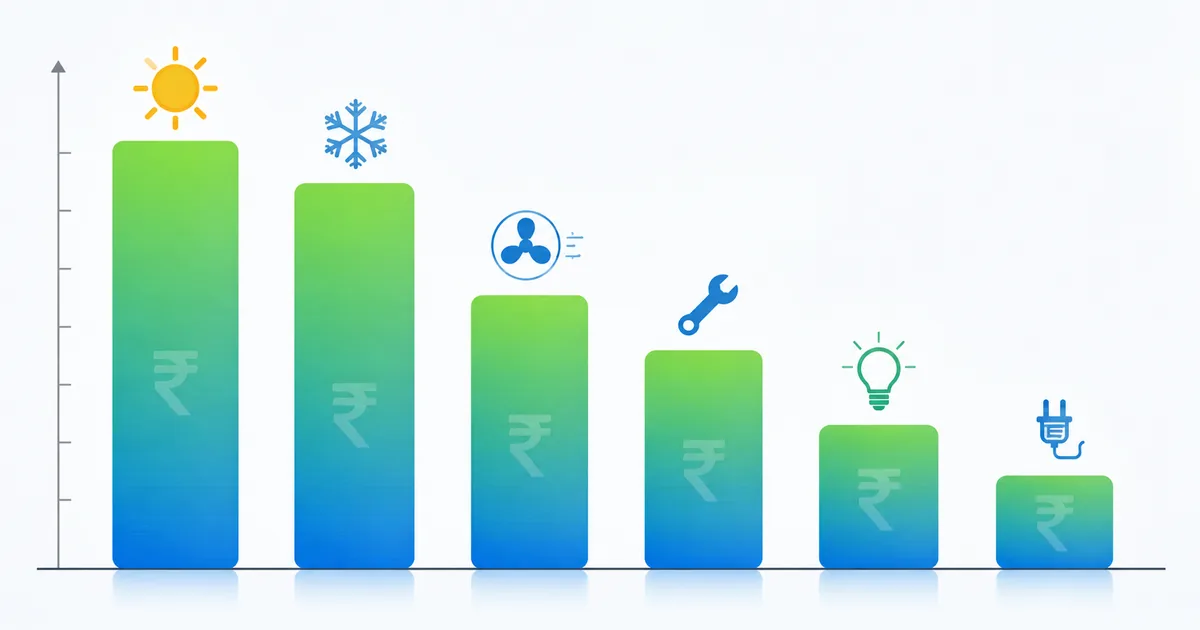
Quick Summary: Savings at a Glance
| Action | Approx. monthly saving | Effort |
|---|---|---|
| AC at 26°C + fan | ₹700-2,500 | Zero cost |
| Clean AC filters | ₹200-600 | Zero cost |
| AC service | ₹300-800 | ₹400-600 once |
| Switch to LEDs | ₹150-400 | One-time |
| Kill phantom load | ₹100-300 | Zero cost |
| Natural ventilation | ₹200-600 | Zero cost |
| Rooftop solar (3 kW) | ₹2,000-4,000 | One-time + subsidy |
Note: Savings are approximate and vary by usage, tariff slab, city, appliance type, and home size. CO₂ figures use the latest available CEA grid emission factor (~0.7 kg CO₂/unit).
The Money-Carbon Connection
Here's what makes electricity saving special: in India, the grid emits roughly 0.7 kg CO₂ per unit (latest available CEA grid emission factor). So the math is simple and powerful:
- Save 100 units/month → save ~₹600-800 AND prevent ~70 kg CO₂
- Save 100 units/month for a year → ~₹8,000 saved AND ~840 kg CO₂ prevented
You don't have to choose between your wallet and the planet. With electricity, every rupee saved is carbon saved.
Make It Stick
- This week: Set AC to 26°C, clean the filters, switch to LEDs.
- This month: Get your AC serviced and start unplugging idle devices.
- This year: If your bill is consistently high, evaluate rooftop solar — the PM Surya Ghar subsidy makes it more affordable than ever.
- Track it: Calculate your footprint and register on HaritKosh to monitor your savings over time.
The Bottom Line
You can't control the heatwave or the tariff hikes. But you can control 30-40% of your bill. Start with the AC — set it to 26°C with a fan today, and you'll feel the difference in your next bill. Then layer on the cheaper fixes, and if your usage is high, let rooftop solar do the heavy lifting.
Lower bills, lower emissions, same comfort. See your numbers →
Sources
- ABP Live — UP electricity tariff hike effective June 1, 2026
- Times of India — 30-40% of summer bill is preventable
- LiveMint — AC at 26°C + fan saves ₹700-2,500/month
- News24 — 5-star vs 3-star AC savings & payback
- CEA — CO₂ Baseline Database for the Indian Power Sector (grid emission factor)
- BEE / Ministry of Power — 1°C higher AC saves ~6% electricity; recommended 24°C
Disclaimer: Savings and CO₂ estimates are approximate and depend on your usage, tariff, city, and appliances. Confirm current tariffs and ToD windows with your local DISCOM.
Keep reading: PM Surya Ghar Rooftop Solar Subsidy 2026 | World Environment Day 2026: 12 Climate Actions | Save Water, Cut Carbon
Frequently Asked Questions
Related Articles

Carbon Credits for Beginners: India's Green Economy Explained
Learn what carbon credits are and how they drive India's green economy in 2026. Beginner-friendly...
Green Hydrogen India 2026: Projects, Cost & Carbon Impact
India's green hydrogen landscape in 2026: major projects, production costs, carbon reduction...
How to Plant a Tree in India: Carbon Offset Guide (2026)
Learn how to plant a tree correctly in India: best season, species selection, step-by-step guide,...