.png?alt=media&token=bfcc71bf-04da-4200-badf-6c9f66c06a3c)
How to Compost Kitchen Waste at Home in India (2026 Guide)
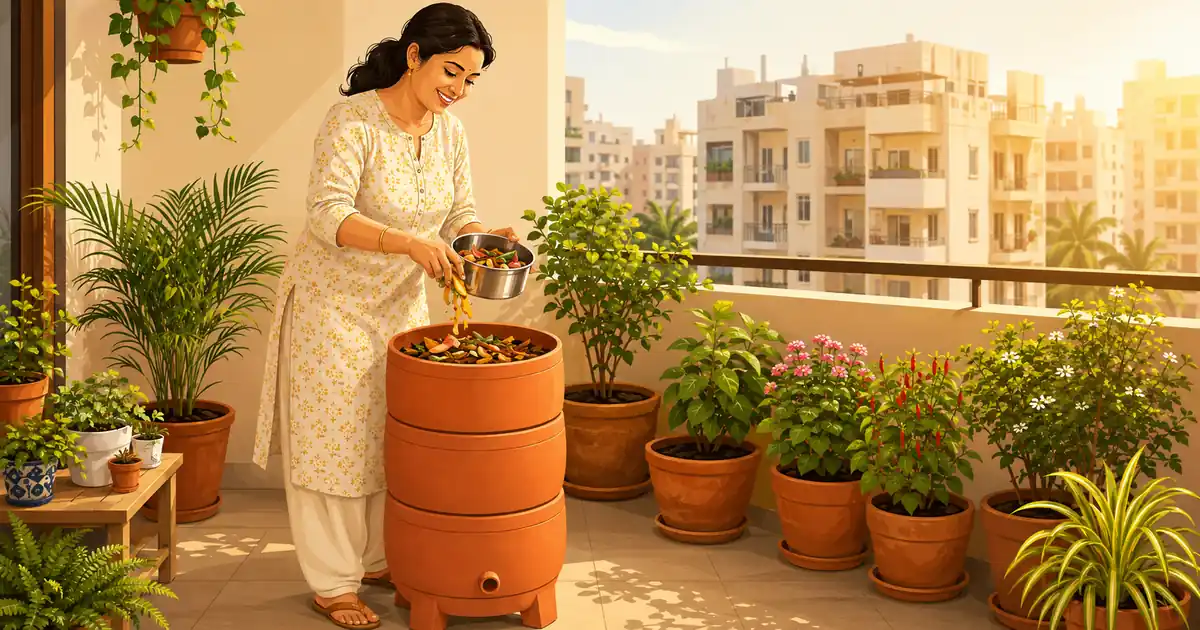
Why Saving Your Kitchen Waste Is a Climate Action
If you live in India, you generated about half a kilogram of organic waste from your kitchen today. Vegetable peels, leftover dal, fruit skins, tea leaves. Most of it landed in a black plastic bag, then a municipal truck, then a landfill on the edge of your city. There, it rots without oxygen and quietly releases methane — a greenhouse gas roughly 28 times more potent than CO₂ at warming the planet.
That's the bad news. The good news: starting April 1, 2026, India's new Solid Waste Management Rules 2026 made four-stream segregation mandatory for every household. Composting at home is one of the easiest ways to support compliance with the new segregation rules while reducing your household carbon footprint.
This guide walks you through exactly how to start.
Why Kitchen Waste Is a Bigger Climate Problem Than People Realise
India generates roughly 1.85 lakh tonnes of solid waste every day, and if around 60% is organic — kitchen scraps, food leftovers, garden waste — that means more than 1.1 lakh tonnes of biodegradable waste may be generated daily. Combined with related sources, India's municipal solid waste produces an estimated ~19 million tonnes of CO₂-equivalent emissions annually when it ends up in landfills (Source: International Climate Initiative).
Two Indian landfill sites — in Secunderabad and Mumbai — were named among the world's biggest methane-emitting landfills in 2025, based on satellite data analysed by Carbon Mapper and the Stop Methane Project at UCLA (Source: Down To Earth).
When you compost at home instead, that same kitchen waste decomposes with oxygen — producing carbon dioxide and useful soil instead of methane. The carbon impact difference is enormous.
India's New SWM Rules 2026: What Households Now Have to Do
The Solid Waste Management Rules 2026 were notified by the Ministry of Environment on January 28, 2026, and took effect on April 1, 2026 (Source: PIB; LiveMint). They replaced the older 2016 framework.
The biggest change is four-stream segregation at source, mandatory for every household:
| Bin | Colour | What Goes In |
|---|---|---|
| Wet waste | Green | Kitchen scraps, vegetable peels, fruit skins, leftovers, garden trimmings |
| Dry waste | Blue | Paper, plastic, glass, metal, cardboard, packaging |
| Sanitary waste | Red | Diapers, sanitary pads, used tissues |
| Special care waste | Black | Batteries, e-waste, broken thermometers, expired medicines |

The rules require wet waste to be composted at source or sent for bio-methanation at nearby facilities. Bulk waste generators — apartment complexes with 100+ units, hotels, large offices — now have specific obligations to process wet waste on site (Source: ET Realty).
Composting at home is no longer just a nice-to-have. It's the easiest way to comply with the new rules while reducing your carbon footprint.
Why This Matters for India Specifically
Three reasons composting is uniquely powerful in the Indian context:
- High organic share: Indian household waste is about 60% organic — much higher than developed countries. Each kilogram you compost matters more here.
- Landfill capacity is collapsing: Cities like Bengaluru, Delhi, and Chennai are running out of landfill space. Mumbai's BMC has already shifted to a wet-waste-to-biogas model precisely because landfills can no longer absorb the volume (Source: UrbanAcres).
- Free fertiliser bonus: A balcony or terrace garden becomes self-sustaining. Compost from kitchen waste replaces store-bought fertiliser worth approximately ₹3,000-7,000 per tonne (Source: Organic Mandya).
The Carbon Footprint Connection
Depending on household size and food-waste quantity, home composting can help avoid an estimated 150–200 kg CO₂-equivalent emissions per year by reducing methane generation from landfill-bound wet waste. Scale that across the 30 crore households in India and the impact becomes national-level.
It's one of the rare green actions where:
- Personal cost is near zero
- Setup time is under an hour
- Ongoing effort is a few minutes a day
- Climate impact is measurable and significant
How to Start Composting at Home: 4 Methods Compared
Different homes need different methods. Here's a practical comparison for Indian conditions:
| Method | Best For | Setup Cost | Time to Compost | Smell Risk |
|---|---|---|---|---|
| Aerobic bin (terracotta khamba) | Houses with balcony/terrace | ₹500–1,500 | 6–8 weeks | Low (if balanced) |
| Vermicomposting (worms) | Gardeners, apartment owners | ₹800–2,000 | 4–6 weeks | None (if done right) |
| Bokashi (fermentation) | Small flats, no outdoor space | ₹1,000–2,500 | 2 weeks + 4 burial | None (sealed bin) |
| Open pile / NADEP pit | Houses with gardens | ₹0–500 | 8–12 weeks | Medium |
- Quickest method for apartments: Bokashi (fermented in a sealed bin, then buried in soil or finished in a pot)
- Best for beginners: Aerobic terracotta bin — widely available on Amazon, Daily Dump, and TrustBin
- Cheapest long-term: Open pile if you have a garden
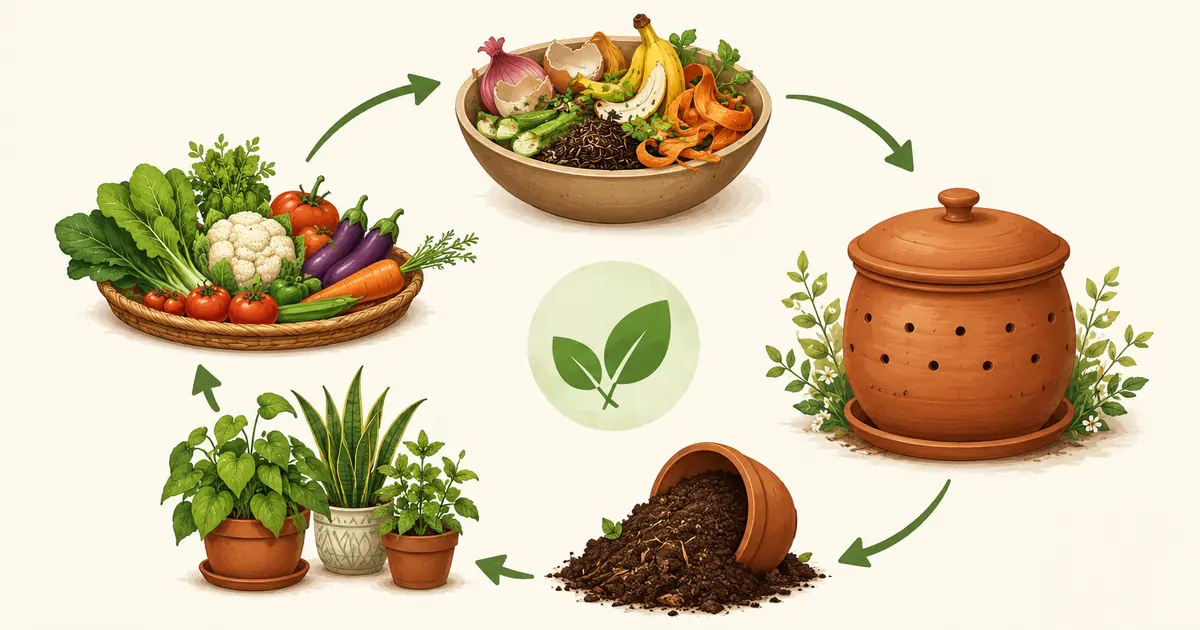
Step-by-Step: Setting Up an Aerobic Compost Bin (Most Common Method)
- Buy or build a bin: A 3-tier terracotta khamba (about ₹1,200) or any aerated plastic bin. It must have ventilation holes and a lid.
- Layer 1 — browns: Add a 2-inch layer of dry leaves, shredded newspaper, or coco peat at the bottom.
- Layer 2 — greens: Add your kitchen waste (peels, vegetable scraps, tea leaves, coffee grounds). Avoid meat, dairy, and oily food initially.
- Cover with browns: Always cap your wet waste with a thin layer of dry material. This is the secret to a smell-free bin.
- Add a compost accelerator: A handful of cow dung, buttermilk, or commercial accelerator powder (₹200/pack) speeds up decomposition.
- Stir every 3-4 days: Use a stick or trowel to mix and bring oxygen into the pile.
- Harvest at 6-8 weeks: Bottom layer turns into dark, crumbly, earthy-smelling compost. Use it on plants or share with neighbours.
What Not to Add
- Meat, fish, bones, dairy (attract pests, cause odour)
- Oily or cooked food in large quantities
- Citrus peels in large amounts (they slow worms and acidify the pile)
- Plastic, glass, metal, sanitary items (these are dry/sanitary waste)
- Pet litter or human/dog waste
Track Your Composting Action on HaritKosh
Composting is a perfect HaritKosh action — it's measurable, repeatable, and directly reduces your carbon footprint. Here's how to use the platform:
- Use the Carbon Footprint Calculator to baseline your current household emissions
- Create a free HaritKosh account and log composting as a recurring eco-action
- Track monthly kilograms diverted from landfill — see your cumulative CO₂ savings build up over the year
- Read more on what is a carbon footprint to understand other actions worth adding
If you live in a Resident Welfare Association (RWA) or apartment complex, document community-level composting too. Under SWM Rules 2026, bulk generators have on-site processing obligations, and verified collective action could become eligible for voluntary carbon credit programmes as the Indian Carbon Market matures.
The Bottom Line
Composting is a quietly radical act. It's one of the few things you can do at home in under an hour that:
- Complies with new law (SWM Rules 2026)
- Cuts your household carbon footprint
- Replaces store-bought fertiliser
- Reduces methane emissions from India's overflowing landfills
Start small. A 5-litre bin, a handful of dry leaves, this week's vegetable peels. Six weeks from now, you'll have your first batch of dark, earthy compost — and a small but real climate win to log on your HaritKosh dashboard.
Sources
- PIB — Solid Waste Management Rules 2026 mandatory four-stream segregation
- LiveMint — Inside India's tougher waste management regime
- ET Realty — Mandatory four-stream segregation from April 1, 2026
- International Climate Initiative — India MSW emissions data (2026)
- Down To Earth — Secunderabad and Mumbai landfill methane emissions (Carbon Mapper / UCLA SPM, 2025)
- UrbanAcres — BMC wet-waste-to-biogas shift (2026)
- Organic Mandya — Organic composting complete guide
Disclaimer: Setup costs, composting timelines, and carbon savings vary by region, climate, household size, and method. Methane's global warming potential is commonly cited at ~28x CO₂ over a 100-year horizon (IPCC range; some recent assessments use 80x over 20 years). Always confirm local SWM compliance with your municipality.
Keep reading: Water Crisis India 2026: Save Water, Cut Carbon | PM Surya Ghar Yojana 2026: Subsidy & How to Apply | Indian Carbon Market 2026 Guide
Frequently Asked Questions
Related Articles

Carbon Credits for Beginners: India's Green Economy Explained
Learn what carbon credits are and how they drive India's green economy in 2026. Beginner-friendly...
Green Hydrogen India 2026: Projects, Cost & Carbon Impact
India's green hydrogen landscape in 2026: major projects, production costs, carbon reduction...
How to Plant a Tree in India: Carbon Offset Guide (2026)
Learn how to plant a tree correctly in India: best season, species selection, step-by-step guide,...